Asthma vs. COPD: How to tell them apart as cold air hits


November is National COPD Awareness Month, and cold, dry air is settling in across much of the U.S. For anyone who wheezes, coughs or gets short of breath this time of year, a common question comes up: is it asthma or COPD?
The short answer: Asthma is long-term inflammation of the airways that flares and eases. COPD (chronic obstructive pulmonary disease) is a group of lung diseases that block airflow and worsen over time. Both cause coughing, wheezing and shortness of breath, which is why they are easy to confuse.
Both are common. CDC figures for 2025 show that 8.5% of adults and 6.3% of children have asthma. Among adults, 4.4% have been diagnosed with COPD, emphysema or chronic bronchitis. The National Heart, Lung, and Blood Institute (NHLBI) notes that many people with COPD do not know they have it. Below, Doctronic explains how to tell asthma and COPD apart as the cold weather arrives.
Key takeaways
- Asthma is airway inflammation that flares and eases, while COPD causes lasting lung damage that slowly worsens
- Asthma typically begins in childhood or young adulthood; COPD usually develops in middle age or later and is most often tied to smoking
- A breathing test called spirometry helps a doctor tell which condition fits
- Cold, dry air can make both worse; covering the nose and mouth and keeping up controller medicines help
- Treatment differs: asthma care centers on anti-inflammatory controller medicines, while COPD care centers on quitting smoking and bronchodilators
What Is Asthma?
Asthma is a chronic condition in which the airways become inflamed and sensitive. During a flare, the airways swell, the muscles around them tighten and extra mucus builds up, so less air gets through. Between flares, breathing is often normal or close to it.
Symptoms come and go. They often get worse at night or early in the morning and tend to follow triggers such as allergens, exercise or cold air. The cough is often dry or brings up small amounts of clear or white mucus, and many people feel tightness in the chest.
Asthma often starts in childhood, and signs of asthma in children include wheezing, a cough that won't go away and trouble keeping up during play. But adults can develop it too, even with no history of breathing problems.
What Is COPD?
According to the NHLBI, COPD is a group of lung diseases, mainly emphysema and chronic bronchitis, that narrow the airways and damage the lungs. The damage is largely permanent, though treatment can ease symptoms and slow the decline.
COPD symptoms tend to be steady rather than on and off, and they slowly get worse. The cough is usually long-lasting and brings up mucus that may be yellow, green or gray. Shortness of breath builds gradually, first during activity. Wheezing can happen, but it is often less prominent than in asthma.
COPD usually appears after years of breathing in lung irritants. Chronic lower respiratory diseases, the group that includes COPD and asthma, were the fifth leading cause of death in the U.S. in 2024, with 145,643 deaths, according to the CDC.
Causes and Risk Factors
Asthma
Asthma comes from a mix of genes and environment. Many people with asthma have a family history of allergies or asthma, and allergens such as dust mites, pet dander, pollen and mold often set off symptoms.
Other triggers include respiratory infections, exercise, cold air, strong odors, stress and certain medicines. In asthma, the immune system overreacts to things that are usually harmless, which leads to swelling and tightening in the airways.
COPD
Tobacco smoke is the main cause of COPD in the U.S., but people who never smoked can still get it. The CDC lists these risk factors:
- Secondhand smoke
- Air pollution
- Dust, fumes and chemicals at work
- Alpha-1 antitrypsin deficiency (a genetic condition) and a family history of COPD
- Having asthma
- Being 65 or older
Continued exposure to smoke and other irritants makes COPD progress faster.
Why Cold Air Makes Both Worse
Cold, dry air irritates the airways, according to the American Lung Association (ALA). It can make mucus thicker and stickier, so it is harder to clear. In people with asthma, breathing cold air during exercise can also set off exercise-induced bronchoconstriction, a sudden narrowing of the airways.
The ALA suggests these steps for cold days:
- Wear a scarf over the nose and mouth.
- Breathe through the nose rather than the mouth.
- Keep taking controller medicines as directed.
- Ask a doctor about using a quick-relief inhaler 20 to 30 minutes before cold-weather activity.
- Stay indoors when the temperature drops below 10 F.
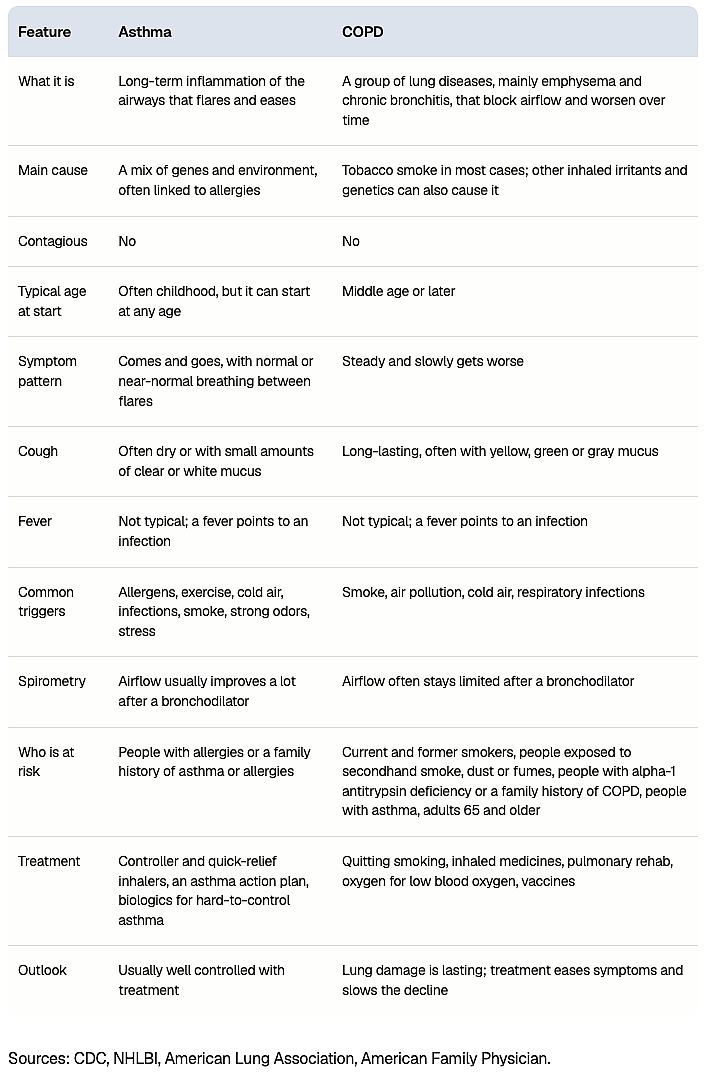
Asthma vs. COPD: Side-by-Side Comparison
How Doctors Tell Them Apart
Doctors use a breathing test called spirometry for both. It measures how much air a person can breathe out and how fast. In asthma, airflow usually improves a lot after a bronchodilator, a medicine that opens the airways. In COPD, airflow often stays limited after a bronchodilator.
Doctors may also use chest X-rays, CT scans and blood tests to rule out other conditions and judge how severe the disease is. Age, smoking history, the symptom pattern and triggers all help them decide which condition fits, and some people have features of both.
How Treatment Differs for Asthma and COPD
Asthma treatment aims for full control of symptoms and fewer flare-ups. Most people use two kinds of medicine: quick-relief and controller inhalers. Controllers, often inhaled corticosteroids, calm airway inflammation day to day. Quick-relief inhalers open the airways fast during a flare. Avoiding personal triggers helps too.
The NHLBI recommends that people with asthma work with their doctor on an asthma action plan, a written plan that lists daily medicines, warning signs and what to do during a flare. For hard-to-control asthma, a doctor may add a biologic, a medicine that targets specific parts of the immune response.
COPD treatment aims to ease symptoms, slow the disease and prevent flare-ups. The CDC lists these parts of COPD care:
- Quitting smoking, the first and most important step
- Inhaled medicines, such as long-acting bronchodilators that relax the airway muscles
- Pulmonary rehabilitation, a program of exercise and breathing training
- Oxygen therapy for people with low blood oxygen
- Flu, COVID-19 and pneumococcal vaccines
Some medicines overlap. Inhaled corticosteroids play a smaller role in COPD than in asthma, and some combination inhalers used for both conditions pair a steroid with a long-acting bronchodilator.
When to See a Doctor, and When to Call 911
See a doctor for any of these:
- A cough that lasts more than a few weeks
- Shortness of breath that is getting worse
- Frequent chest infections
- Wheezing that keeps coming back
- Needing a rescue inhaler more often than usual, or waking at night with symptoms
The NHLBI advises current and former smokers to ask a doctor about COPD testing. When a regular doctor isn't available, urgent care can see people with worsening symptoms, and people already diagnosed can get COPD care online.
Call 911 if a rescue inhaler isn't working, breathing is severely difficult, lips or fingernails turn blue, or there is confusion or extreme fatigue.
Frequently Asked Questions
Can you have both asthma and COPD?
Yes, some people have both. Doctors may call this asthma-COPD overlap, a description of patients with features of both rather than a separate disease; about one in four people with COPD also have asthma.
Can asthma turn into COPD?
They are separate conditions, but having asthma is one of the risk factors the CDC lists for COPD, and some people end up with features of both. A doctor can track lung function over time with spirometry.
Which is more serious, asthma or COPD?
Both can be serious. Asthma can cause sudden, life-threatening attacks, and the CDC recorded 3,722 asthma deaths in the U.S. in 2024. COPD causes a lasting loss of lung function, which can make daily activity harder over time. Good treatment improves the outlook for both.
Are asthma and COPD inhalers the same?
Some are. Both conditions use quick-relief and long-acting inhalers, and some combination inhalers are used for both. Asthma care centers on inhaled corticosteroids to control inflammation, while COPD care centers on long-acting bronchodilators.
Does cold weather make COPD and asthma worse?
Yes, for many people. Cold, dry air irritates the airways and thickens mucus, and in people with asthma it can narrow the airways during exercise. Covering the nose and mouth and staying in on very cold days can help.
Can people who never smoked get COPD?
Yes. Smoking is the main cause, but secondhand smoke, air pollution, workplace dust and fumes, alpha-1 antitrypsin deficiency or a family history of COPD, having asthma and being 65 or older can all raise the risk.
The Bottom Line
Asthma and COPD can feel alike, but they behave differently. Asthma flares and eases and can usually be well controlled, while COPD causes lasting lung damage that treatment can slow. Cold weather can make both harder to manage. Anyone with a lingering cough, wheezing or shortness of breath, especially a current or former smoker, can ask a doctor about a spirometry test to find out which condition fits.
This story was produced by Doctronic and reviewed and distributed by Stacker.