The best time to buy a car, according to Edmunds data

The best time to buy a new car in 2026 is near the end of the year, according to Edmunds analysts. New car discounts tend to increase in the late summer to fall months when the latest car models hit dealership lots in greater numbers. As these new cars arrive, dealerships need space to park them, and the best way to make room is to lower the prices on previous-year models. The last part is important to remember. Don’t expect the same level of discounts on this year's models as you would see on last year's.
There's more to determining the best time to buy a new car. The automotive marketplace and the U.S. economy have begun to stabilize slightly in 2026, though where it's stopping might not be to everyone's liking.
Current car market conditions
The average transaction price (the total cost of the car plus fees) for a new vehicle hit a record high of $49,639 in September 2026, according to Edmunds sales data. Interest rates for car loans have remained high, averaging about 7% through most of 2026. Note that interest rates can vary widely from state to state, not to mention from buyer to buyer.
Both automakers and car buyers were surprised last year when the Trump administration introduced tariffs and by how quickly the situation kept changing.
"2026 hasn’t been as turbulent, and automakers have tried to hedge their bets to reduce disruptions from future tariff changes," said Ivan Drury, director of insights for Edmunds. He added that buyers in 2026 can feel more confident that they won't see the dramatic changes or low inventory issues that plagued the industry in prior years.
If you're in the market for a new car today, there's one possible benefit to rising new car prices: More shoppers trading in their vehicle are realizing that it is worth more than they expected.
When are the best times to buy a car?
Given that every buyer can't wait until the "perfect car buying conditions" appear, here's some realistic advice: The best time to buy a car is when you need it and feel ready to buy, regardless of the time of year.
With the car market, it can sometimes feel like Murphy's law is in effect, as something inevitably challenging will come up. Whether it's high interest rates, limited inventory or low trade-in values, car buying can be stressful, and it can take a long time to go from deciding what to buy to actually closing the deal. Why add to that pressure by trying to squeeze your shopping into a certain day of the week or a holiday weekend when everyone has the same idea?
But if you're a bargain hunter who really wants to pinpoint the best time to buy, let's examine your options.
Best time of the year to buy a car
Best month to buy a car
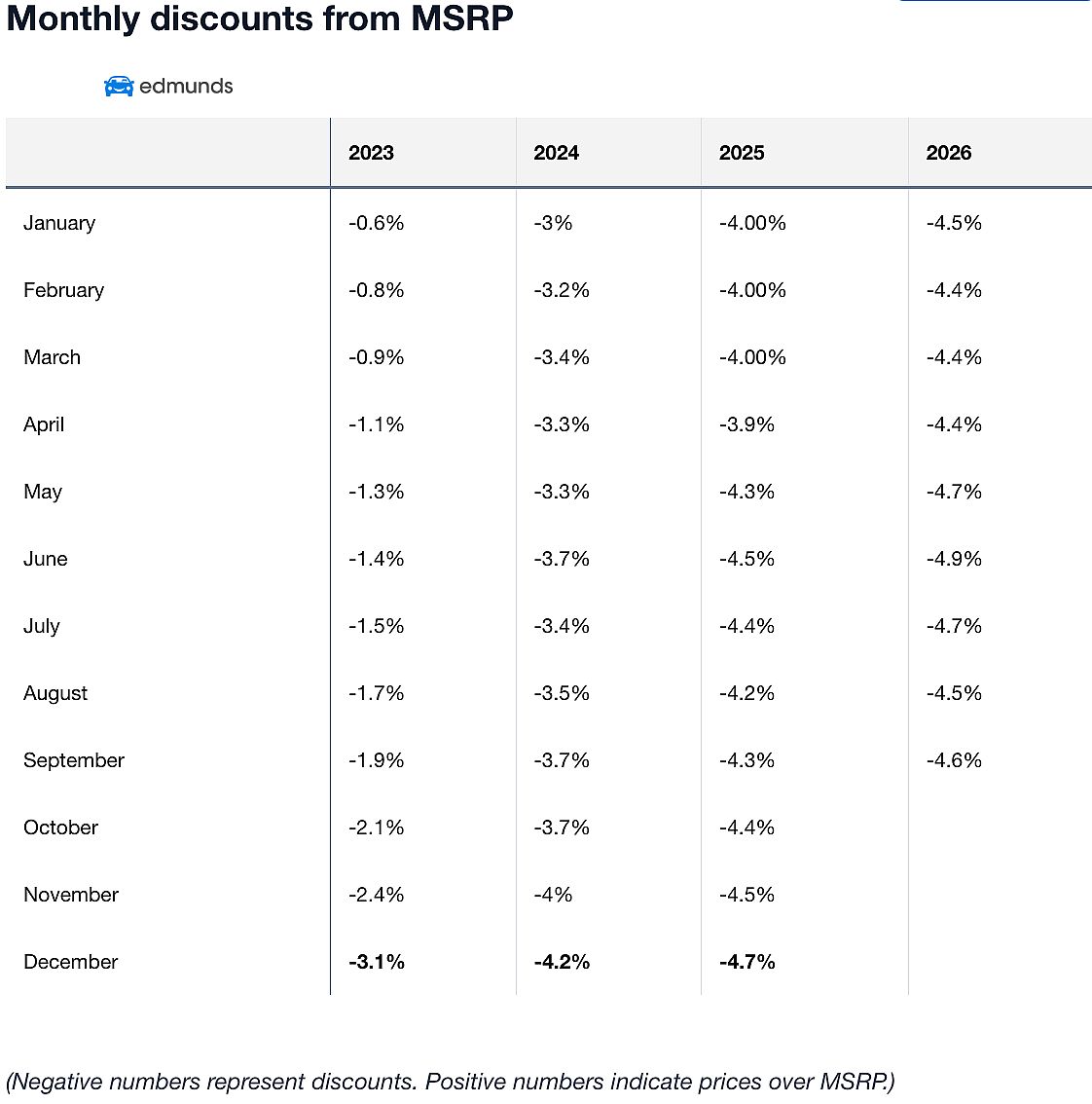
Apart from a few years in the pandemic when everything was thrown for a loop, December has been the month with the highest discounts off MSRP.
"The traditional norms are back, said Drury. "The longer someone can wait, the better; discounts at the end of this year should be more generous."
This is reflected in the table below, based on Edmunds data through September 2026. You'll see that the percentage off MSRP has been steadily increasing in recent years.
End of the month
As the month comes to an end, dealers might be a few cars short of meeting the sales quota, which could earn them an additional bonus. In these situations, salespeople have greater motivation to close a deal and might offer deeper discounts on cars, making up any lost money with the bonus. This is one of those times when buyers should not sleep on a car deal.
However, if the sales team has already met its monthly quota, a salesperson may be less motivated to give you the deal you expect. This is hard to know ahead of time. But if you're in the middle of negotiating and you are offered a very low price, ask your salesperson why the dealer is willing to "lose money" on this sale. If the reason makes sense and the price is much better than your research suggests, it could mean the dealer is trying to meet a sales goal.
If you're nervous about buying near the end of the month, test-drive the car earlier and close the deal at the end of the month. Also, many new-car incentives last a few days after the month ends, giving you a buffer.
End of the calendar year
The end-of-the-calendar-year strategy follows the same logic as the end-of-the-month strategy. Dealership sales departments that have not made their sales goals for the year will want to finish off the year as close to their goals as possible. The difference here is that late December also coincides with the time that dealerships are looking to get rid of any remaining current-year vehicles to make room for newer ones.
That said, each manufacturer handles its end-of-the-year sell-down differently. This means that some car dealerships will have a better selection of outgoing-year vehicles late in the year, while the pickings could be slim at others. There's always a balance to be struck between getting a better deal and having more options to choose from — rarely can you have both.
Best day to buy a car
Early in the week: This tip is more about the level of attention you can expect from a salesperson than about getting a killer deal. Weekends are typically the busiest time at a dealership. The salesperson might be juggling multiple customers, and the finance office is likely to be a bottleneck. But if you show up on a Monday or Tuesday, there will be less foot traffic. You can ask plenty of questions, and the transaction should take far less time. In some parts of the country, however, dealerships are closed on Sundays. And as a result, Monday is a pretty busy day of the week. If that's the case for you, go on a Tuesday or Wednesday.
Best times to buy a car
End of the model year
All the new model-year cars used to debut in the fall, making the end of summer a good time to shop for leftovers. These days, however, there is no unified new model-year season. For example, cars from the upcoming model year now debut as early as January of a calendar year.
Edmunds analysts say that August and September are when they generally see automakers make the most concentrated effort to transition to new models. In the past, the summer months tend to correspond with a bump in incentives, particularly low-APR financing on outgoing model-year vehicles.
Something to note: It's worth looking at the incoming model-year cars to see what features have changed and to get a feel for pricing. It's rare, but there have been instances when a car from the incoming model year has had better incentives than a car from the outgoing model year, particularly if you're looking to lease.
End of the car's design cycle (before a redesign)
When a manufacturer has announced a redesign or redesigned a car model, you will often find greater savings on the outgoing model. True, you are buying a car without the latest styling or technology, but if you're more of a bargain hunter than a trendsetter, this might not matter to you.
End of the car's life cycle (discontinued model)
Sometimes, the manufacturer announces that it will stop making a car altogether. There's potential in this situation for even bigger savings. You should know that the car will likely depreciate sharply if it's discontinued, but if you plan to keep it for a while, it won't affect you much. It's also worth looking into why the automaker is pulling the plug on a given vehicle. Is it a matter of changing tastes, or was the car subpar in terms of performance or reliability? For example, most domestic automakers have discontinued many sedans in favor of more popular SUVs.
Best holidays to buy a car
3-day weekends
It's hard to miss the inflatable eagles, gorillas and wacky waving tube men that dot car lots on three-day weekends, to say nothing of ads that promise "rock-bottom" prices. Does a "Star-Spangled Sale-a-Bration" mean savings for you? Possibly.
Whether it is Presidents Day, Memorial Day, Fourth of July, or Labor Day, be prepared for a busier-than-normal showroom. Ideally, you want to do your research, take a test drive before the holiday, and close the deal on the weekend. Or better yet, wrap up the deal on the first weekday after the weekend.
Black Friday
Black Friday is the biggest retail shopping day in the U.S., and the same shopping fervor tends to happen on car lots after Thanksgiving. Automakers and dealers will offer more incentives, discounts and "doorbusters" as a means of capturing some of that retail excitement. Black Friday also coincides with the end of the model year, which means that you'll likely see greater discounts on outgoing models throughout the month, so don't feel pressured to wrap up the deal on that one day.
If you want to shop on Black Friday, you'll need to do some pre-Thanksgiving planning, such as obtaining a value on your trade-in, getting preapproved for an auto loan from your bank or credit union, and taking test drives. Also, make sure you read the fine print on any Black Friday deal ads that seem too good to be true.
What time of year do new car models come out?
These days, new vehicles are launched throughout the year, though there tend to be clusters of new models in the spring and fall.
The U.S. Environmental Protection Agency actually has rules on how a vehicle is assigned a given model year: "For engines/equipment subject to emission standards based on model years, the first day of the annual production period can be no earlier than January 2 of the calendar year preceding the year for which the model year is named, or the earliest date of manufacture for any engine/equipment in the engine family, whichever is later. The last day of the annual production period can be no later than December 31 of the calendar year for which the model year is named or the latest date of manufacture for any engine/equipment in the engine family, whichever is sooner."
In other words, a 2027 model-year vehicle can be released at any time on or after Jan. 2, 2026. Similarly, a new model can be labeled as a 2027 all the way until Dec. 31, 2026.
Final thoughts on when to buy a car
As noted, you'll find many opportunities throughout the year to get a great deal on a new car. Ultimately, the best time to get a new car is when you need one and only after you have completed your research.
Get an appraisal for your current car, so you know how much it's worth as a trade-in. Next, figure out the market value of the car, and factor in any incentives and rebates. Locate the vehicle you're interested in, and determine how the asking price compares to what others are paying to provide perspective on whether you have a fair offer. Watch for unexpected add-ons. Then make your deal. In the long run, this approach makes more sense than trying to predict the effects of weather, holidays, and the seasonality of your car purchase.
This story was produced by Edmunds and reviewed and distributed by Stacker.


Other items that may interest you