How much you're paying to skip streaming ads

If you have even one streaming subscription, you've probably gotten an email saying it is getting more expensive. You have to decide whether to cancel it, keep paying, or switch to a cheaper plan and start watching commercials.
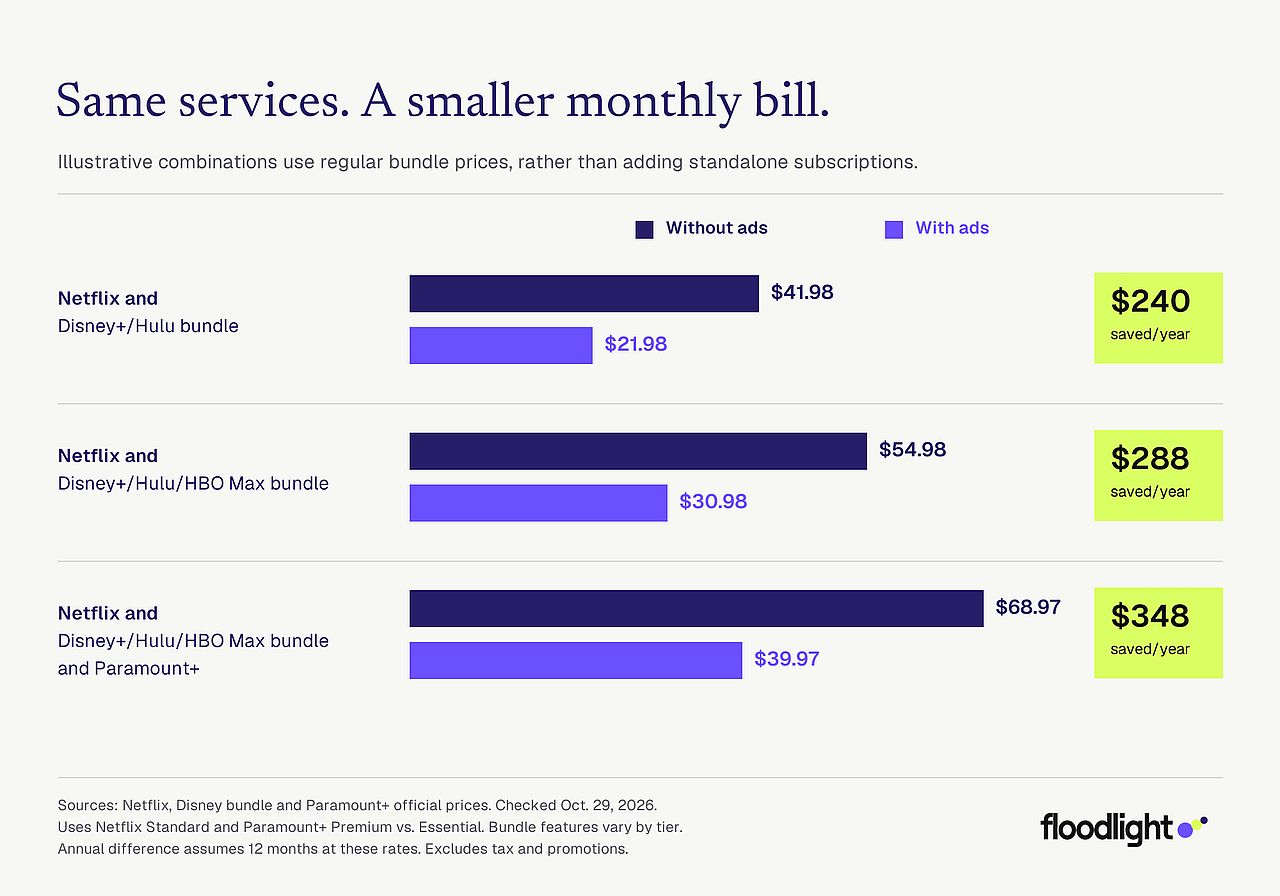
The difference can look small when you're looking at one subscription, but if you're paying for Netflix, Disney+, and Hulu, choosing their ad-supported options instead of their standard ad-free plans can save you $20 a month, or $240 a year, based on current Netflix Standard and Disney+/Hulu bundle prices.
You would have to sit through commercial breaks. Depending on the service, you might also lose something else.
Below, Floodlight, a programmatic ad solutions provider, examines how much viewers can save with ad-supported streaming plans and what they give up in return.
What you're paying to skip
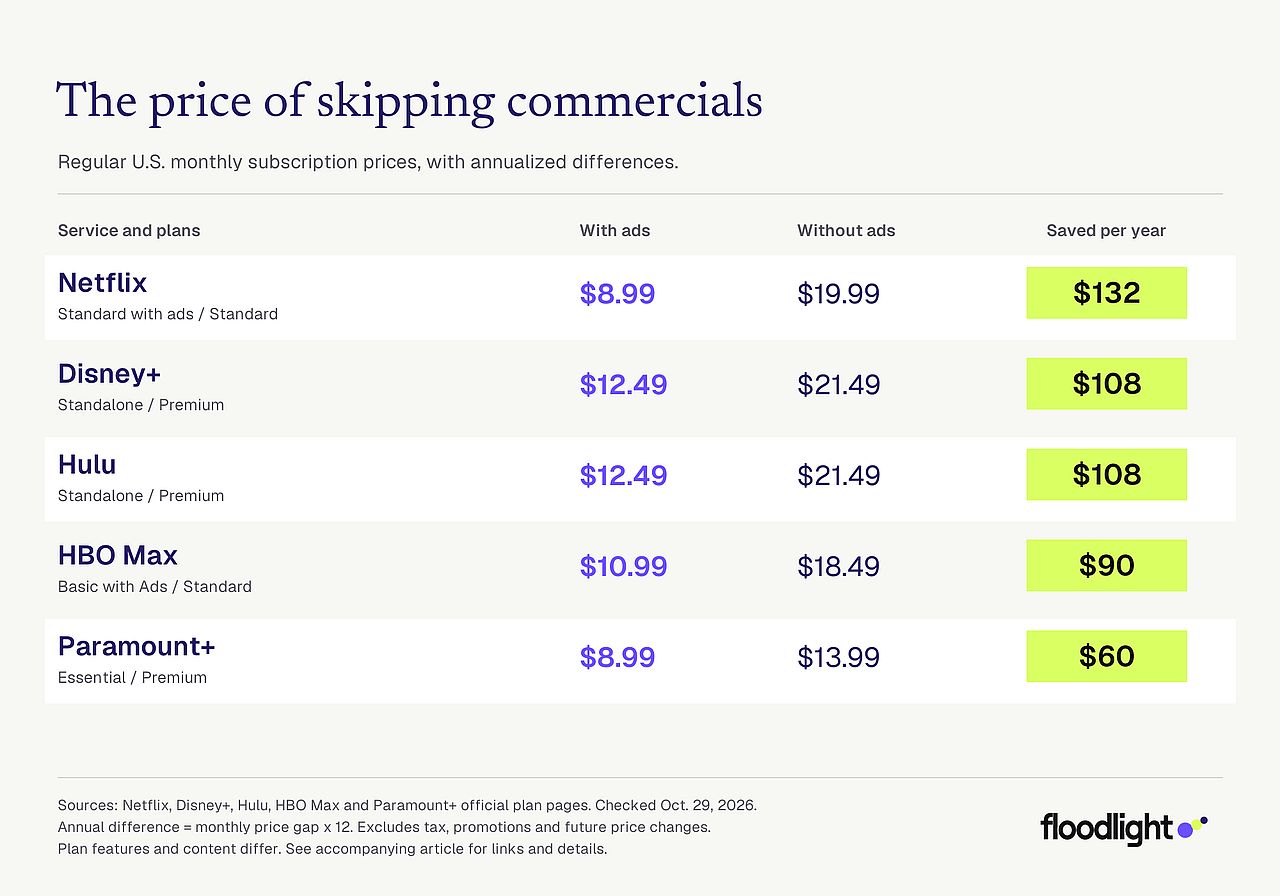
Netflix charges $8.99 per month for Standard with ads and $19.99 per month for Standard without ads. Both let you watch on two devices at once. So, if those are the features you use, you're paying an extra $11 a month, largely to avoid commercials and access titles unavailable on the ad-supported plan. Over the course of the year, that shakes out to $132.
Disney+ and Hulu use different calculations because of their bundling. Each service's standalone ad-free plan costs $21.49 a month, according to Disney+'s pricing and Hulu's pricing. But you can get both together without ads for $21.99, or with ads for $12.99.
If you already have that bundle, switching to ads saves $9 a month. Comparing the prices of two separate subscriptions would make the savings look much bigger than they actually are for you.
Regular monthly rates. Plans may differ in content and features beyond advertising.
Here's what that looks like across a few combinations:
Floodlight calculations use regular U.S. monthly prices checked Oct. 29, 2026, from Netflix, Disney's bundles, and Paramount+. Comparisons use Netflix Standard and Paramount+ Premium versus Essential. Annual savings assume the same prices and subscriptions for 12 months. Taxes and temporary promotions are excluded. Features vary between plans.
Household examples account for regular bundle prices. They are illustrative combinations, not average household savings.
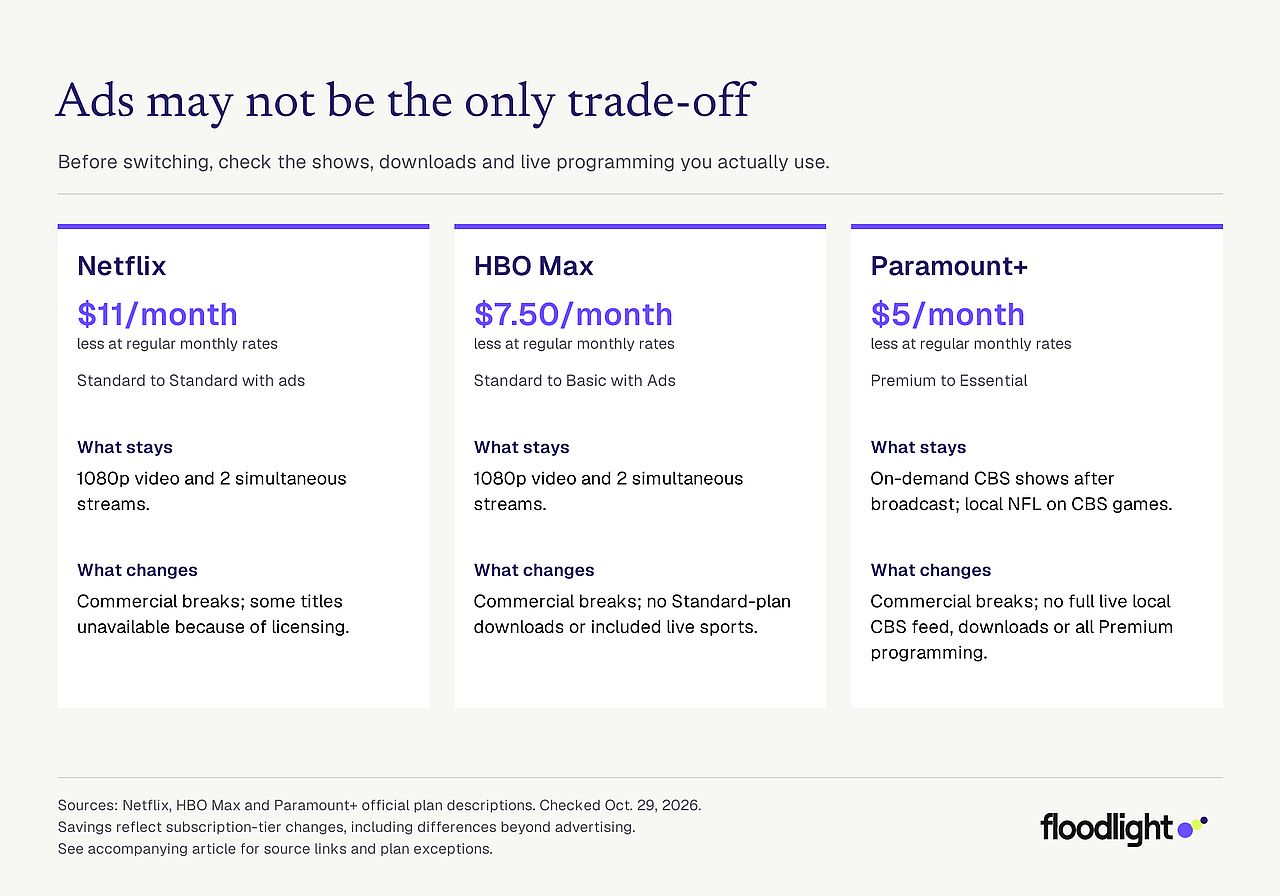
The commercials aren't always the only difference
For example, if you like to download shows before a flight or use Paramount+ to watch your local CBS station live, downgrading to the cheaper plan could change how you watch, even if you don't mind ads.
Paramount+ Essential costs $8.99 a month, compared with $13.99 for Premium. Essential lets you watch current CBS shows on demand after they air, but doesn’t include a live feed of your local CBS station. One important exception: Essential subscribers can watch local NFL on CBS games through a separate live feed. Premium also includes downloads, access to your local live CBS station and additional programming.
HBO Max has a similar setup. Basic with Ads costs $10.99 per month, while Standard costs $18.49 per month. Both allow for 1080p viewing on two devices at once, but Standard adds downloads and the service includes live sports. So that extra $7.50 a month buys you more than fewer commercial breaks.
Check the programming and features you use before switching subscription tiers.
And paying for an ad-free plan doesn't mean every part of the service will be commercial-free. Disney+ makes exceptions for select live and linear programming. Paramount+ still carries ads during live television so if you're mainly subscribing to watch live coverage, paying more will not remove ads the network is showing.
It's similar to how football fans move between individual games and RedZone. Switching the channel during a commercial break can still put you in front of another commercial, sponsored graphic or segment during the coverage you switched to watch.
How much is uninterrupted viewing worth to you?
According to Deloitte, 65% of paid streaming subscribers had at least one ad-supported service, and about 50% of them were looking for ways to reduce their monthly streaming service bill.
For them, and for you, the good news is that you are able to make that decision differently for each service. If Netflix is your go-to service every night, keeping it ad-free might be worth the extra $11 per month. If you only use Disney+ or Hulu a few times per month, having commercials on that bundle would still give you access while saving you $108 a year.
For the corporations buying connected TV advertising, those decisions determine where they can reach you with ads. The same person can watch one service without commercial breaks, another with ads, and a live game that carries commercials regardless of their plan.
So, you might spend the same night watching the same shows on the same services. What changes is how much you pay, which features you will keep, and whether companies get the opportunity to put a commercial in front of you.
This story was produced by Floodlight and reviewed and distributed by Stacker.


Other items that may interest you